Shop & Support the Mission

    Fresh nectar in a minute.

    Every bag of NectarBloom™ funds the guides, the Hummingbird Trail, the lab testing, and the free care resources on this site. When you buy our nectar, you help us keep hummingbird education open, honest, and growing — for every bird lover, everywhere.

    NectarBloom 2 lb bag — pure cane sugar hummingbird nectar

    NectarBloom™ — 2 lb Bag

    Fresh nectar in a minute.

    No boiling, no dye. The same sugar hummingbird flowers make. One ingredient, nothing else. Makes up to 160 oz of fresh feeder nectar per bag.

    • Fresh nectar in a minute: measure, stir until clear, and pour
    • No boiling, no dye
    • The same sugar hummingbird flowers make
    • One ingredient, nothing else: 100% pure cane sugar
    • Lab tested. Resealable 2 lb bag, sourced and packed in the USA

    1 Bag · 2 lb

    $21.99

    Free shipping included

    Best Value

    2 Bags · Season Supply

    $39.88

    Free shipping included

    Direct orders are temporarily sold out. NectarBloom™ is still available on Amazon.

    Buy on Amazon

    Ships fast via Amazon Prime

    See full product details

    Direct orders temporarily unavailable

    “Your purchase isn’t just nectar — it’s how we keep this hummingbird care library free, accurate, and growing.”

    Thank you for flying with us

    Overview

    Idaho is an underrated hummingbird state with strong mountain and intermountain habitat. Black-chinned, Calliope, Rufous, and Broad-tailed Hummingbirds all occur in the state, with Calliope especially associated with higher mountain areas. Idaho's best hummingbird experiences often come from a mix of research sites, wildlife refuges, forest edges, and native flowering corridors rather than traditional public gardens alone. Spring and summer bring the most activity, while late summer can add movement from migrating Rufous and Calliope Hummingbirds. The best season is generally May through August, especially in foothill and mountain habitats.

    Audubon chapters and reader sightings in Idaho

    Filter gardens
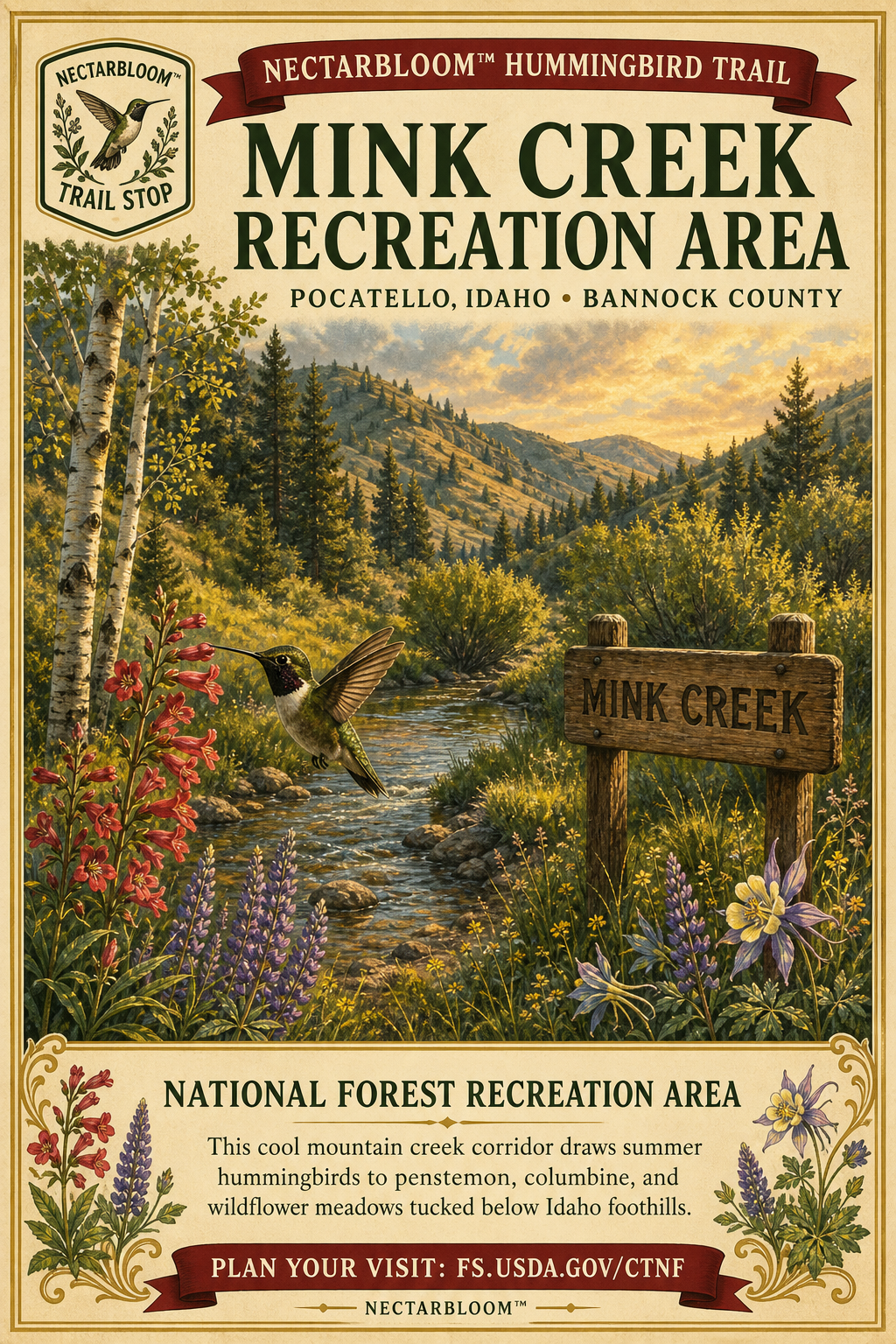
    View Mink Creek Recreation Area — Caribou-Targhee National Forest in Pocatello, IdahoHummingbirds at Mink Creek Recreation Area — Caribou-Targhee National Forest in Pocatello, Idaho
    Map

    Bannock County

    Mink Creek Recreation Area — Caribou-Targhee National Forest

    Pocatello

    South of Pocatello, Mink Creek Road winds into the Caribou-Targhee National Forest to reveal one of southern Idaho's most productive hummingbird-birding corridors. The Kinney Creek Trail and Cherry Springs Nature Area — explicitly named by the National Audubon Society as a prime Idaho birding destination — host four hummingbird species in breeding season: Black-chinned, Broad-tailed, Calliope, and Rufous. This overlap of species is ecologically significant, representing a meeting point of the Rocky Mountain and Pacific flyway corridors. The riparian wildflower habitat along Mink Creek — penstemon, larkspur, columbine, and red-tubular mountain natives — provides exactly the sequence of nectar resources that sustains multiple species through the breeding and migration seasons.

    National Forest Recreation Area / Birding HotspotBlack-chinnedBroad-tailed+2 more

    View garden →

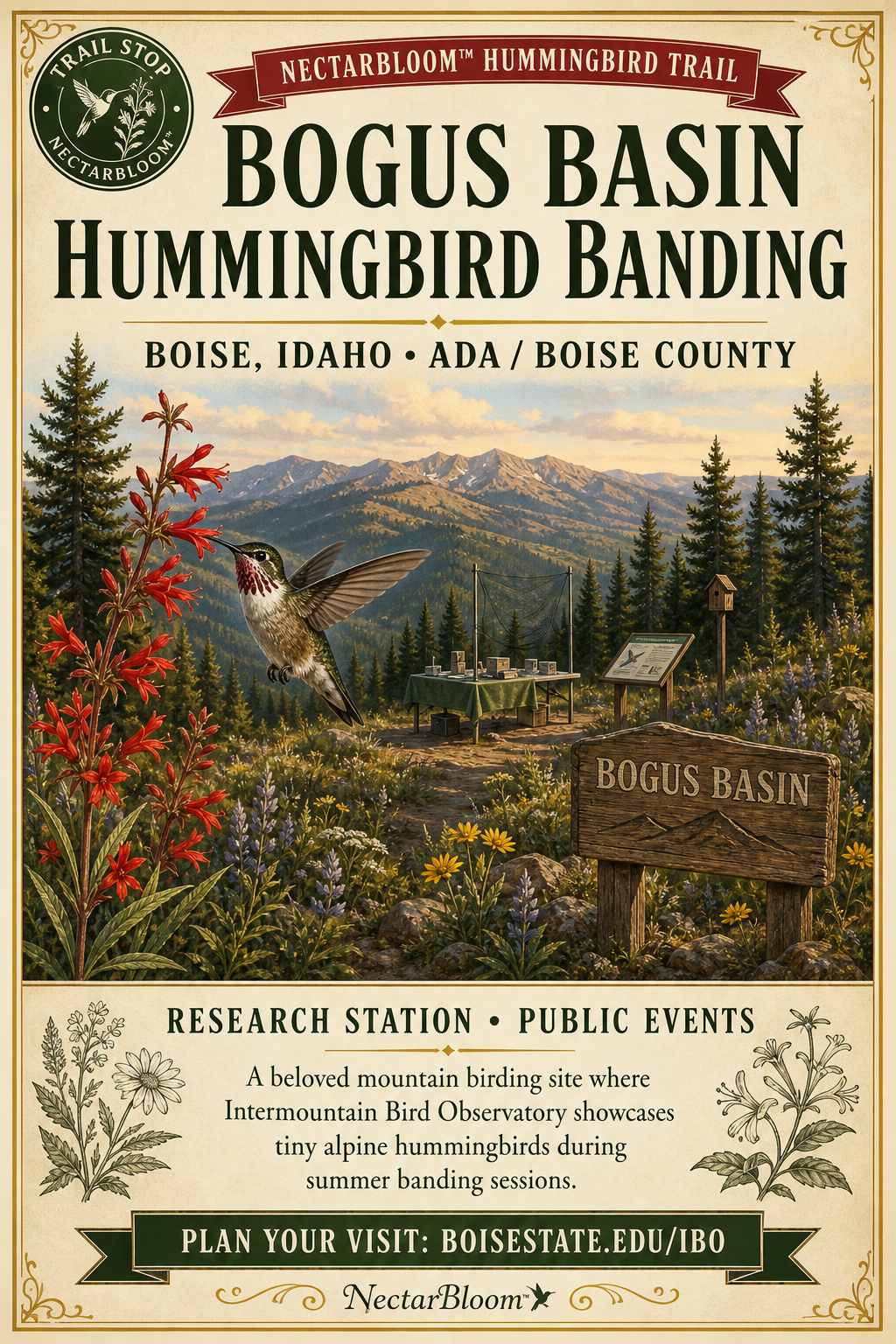
    View Bogus Basin Hummingbird Banding Station — Intermountain Bird Observatory in Boise (Bogus Basin area), IdahoHummingbirds at Bogus Basin Hummingbird Banding Station — Intermountain Bird Observatory in Boise (Bogus Basin area), Idaho
    Map

    Ada / Boise County

    Bogus Basin Hummingbird Banding Station — Intermountain Bird Observatory

    Boise (Bogus Basin area)

    High on the slopes of Bogus Basin above Boise, scientists from the Intermountain Bird Observatory at Boise State University run one of Idaho's most exciting hummingbird encounters: a public banding station where visitors can watch researchers catch, band, and release hummingbirds throughout summer. Five species have been documented at the Frontier Point Lodge station — Black-chinned, Broad-tailed, Calliope, Rufous, and Anna's — making it a genuinely multi-species destination. The banding research examines migration timing, survival rates, and nesting success, contributing directly to conservation science for several Bird of Conservation Concern species. For visitors who want to see hummingbirds in scientists' hands while learning about cutting-edge conservation research, Bogus Basin is an irreplaceable destination.

    Research Station / Public Banding EventsBlack-chinnedBroad-tailed+3 more

    View garden →

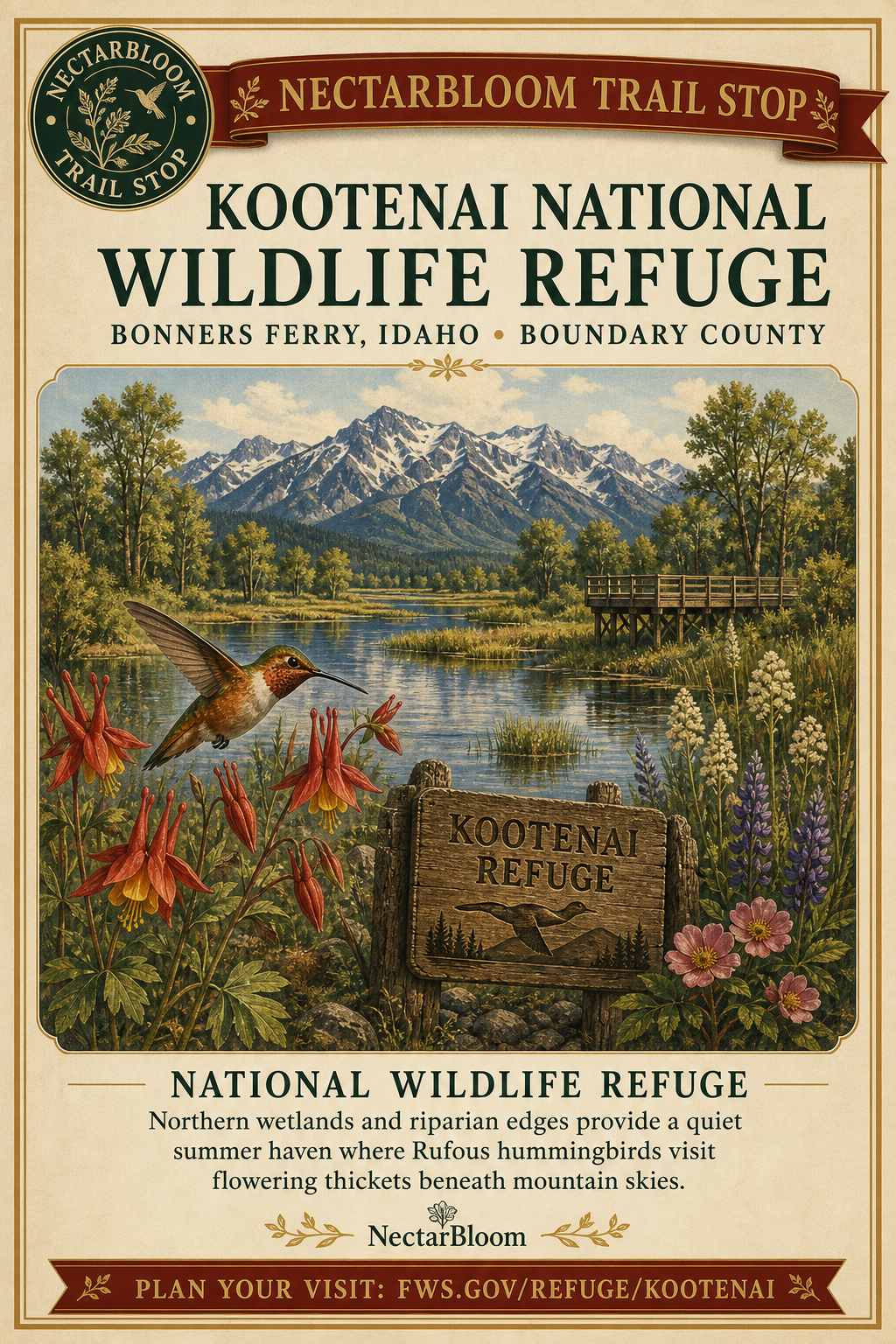
    View Kootenai National Wildlife Refuge in Bonners Ferry, IdahoHummingbirds at Kootenai National Wildlife Refuge in Bonners Ferry, Idaho
    Map

    Boundary County

    Kootenai National Wildlife Refuge

    Bonners Ferry

    In the far north of the Idaho Panhandle, Kootenai National Wildlife Refuge protects a spectacular reach of the Kootenai River valley against a backdrop of the Selkirk Mountains. The refuge's mosaic of wetlands, meadows, and shrub habitats supports 220 documented bird species, including three regularly occurring hummingbird species: Rufous, Calliope, and Black-chinned. The auto tour route makes the refuge highly accessible, and BirdWatching Daily magazine has recognized Kootenai as one of the notable western birding hotspots. For visitors making their way through the Idaho Panhandle, this northern Idaho refuge offers an evocative combination of mountain landscape photography and quality hummingbird encounters in a remote, peaceful setting.

    National Wildlife RefugeRufousCalliope+1 more

    View garden →

    Best Time to See Hummingbirds in Idaho

    Peak hummingbird activity in Idaho typically runs May, June, July, August. Spring migration brings the highest diversity, with early morning and late afternoon being the best viewing hours.

    Typical arrival
    Late March (south) – May (north)
    Typical departure
    Early September
    Hang your feeder
    Two weeks before local thaw

    Multiple species; Broad-tailed Hummingbirds are usually first in. See the full state-by-state feeder timing guide.

    Map of Hummingbird Locations in Idaho

    Switch the view above to to see featured locations plotted geographically.

    Common Hummingbird Species in Idaho

    • Black-chinned Hummingbird
    • Calliope Hummingbird
    • Rufous Hummingbird
    • Broad-tailed Hummingbird
    • Anna's Hummingbird (special expanding visitor)

    Counties on the Hummingbird Trail

    Hummingbird Questions About Idaho

    When do hummingbirds arrive in Idaho?

    Hummingbirds typically arrive in Idaho in Late March (south) – May (north) and leave again by Early September. Multiple species; Broad-tailed Hummingbirds are usually first in.

    When should you put out hummingbird feeders in Idaho?

    Hang feeders in Idaho by Two weeks before local thaw — about one to two weeks before the first birds arrive in Late March (south) – May (north) — so early migrants find your feeder immediately.

    What kinds of hummingbirds live in Idaho?

    The hummingbird species regularly recorded in Idaho are: Black-chinned Hummingbird, Calliope Hummingbird, Rufous Hummingbird, Broad-tailed Hummingbird, Anna's Hummingbird (special expanding visitor).

    Share Your Visit

    Saw hummingbirds in Idaho? Help fellow flock-watchers by sharing a photo, rating, and note from your visit.

    Fresh nectar in a minute.

    Buy on Amazon