How Hummingbirds See Color: Inside the Tetrachromatic, Ultraviolet-Seeing Eye
Hummingbirds have four cone types and see ultraviolet — letting them perceive nonspectral colors like UV+green. What the research shows, and what it means for feeders and flowers.
• 8 min read
By Robert L Traister — Founder & Editor, NectarBloom™
Founder of NectarBloom™ and editor of its hummingbird research library, writing from Overland Park, Kansas.
Reviewed and updated · Editorial standards
Shop & Support the Mission
Fresh nectar in a minute.
Every bag of NectarBloom™ funds the guides, the Hummingbird Trail, the lab testing, and the free care resources on this site. When you buy our nectar, you help us keep hummingbird education open, honest, and growing — for every bird lover, everywhere.

NectarBloom™ — 2 lb Bag
Fresh nectar in a minute.
No boiling, no dye. The same sugar hummingbird flowers make. One ingredient, nothing else. Makes up to 160 oz of fresh feeder nectar per bag.
- Fresh nectar in a minute: measure, stir until clear, and pour
- No boiling, no dye
- The same sugar hummingbird flowers make
- One ingredient, nothing else: 100% pure cane sugar
- Lab tested. Resealable 2 lb bag, sourced and packed in the USA
1 Bag · 2 lb
$21.99
Free shipping included
2 Bags · Season Supply
$39.88
Free shipping included
Direct orders are temporarily sold out. NectarBloom™ is still available on Amazon.
Buy on AmazonShips fast via Amazon Prime
“Your purchase isn’t just nectar — it’s how we keep this hummingbird care library free, accurate, and growing.”
Thank you for flying with us
A hummingbird hovering in front of a garden is not looking at the scene you are looking at. It is reading a fourth color channel that the human eye does not possess — an ultraviolet dimension layered on top of red, green, and blue — and combining it with the colors we share to perceive hues that have no name in any human language.
This is not a metaphor. It has been measured in the retina and confirmed in the field with trained wild birds.
Quick Answer: How Do Hummingbirds See Color?
Hummingbirds are tetrachromats: their retinas contain four classes of single cone, with peak sensitivities near 371 nm (ultraviolet), 444 nm, 508 nm, and 560 nm (Herrera et al. 2008, green-backed firecrown). Humans have only three cone classes and no UV cone. The fourth channel lets hummingbirds perceive nonspectral colors — combinations such as UV+red and UV+green that cannot be produced by any single wavelength. Field experiments with wild broad-tailed hummingbirds showed the birds reliably discriminate these nonspectral hues while foraging (Stoddard et al. 2020, PNAS).
Four Cones, Not Three
Human color vision runs on three cone types — short, medium, and long wavelength — and every color you have ever seen is a ratio between those three signals. Birds retained a fourth cone class that mammals lost during a long nocturnal chapter of early mammalian evolution. Hummingbirds kept it and pushed it into the near-ultraviolet.
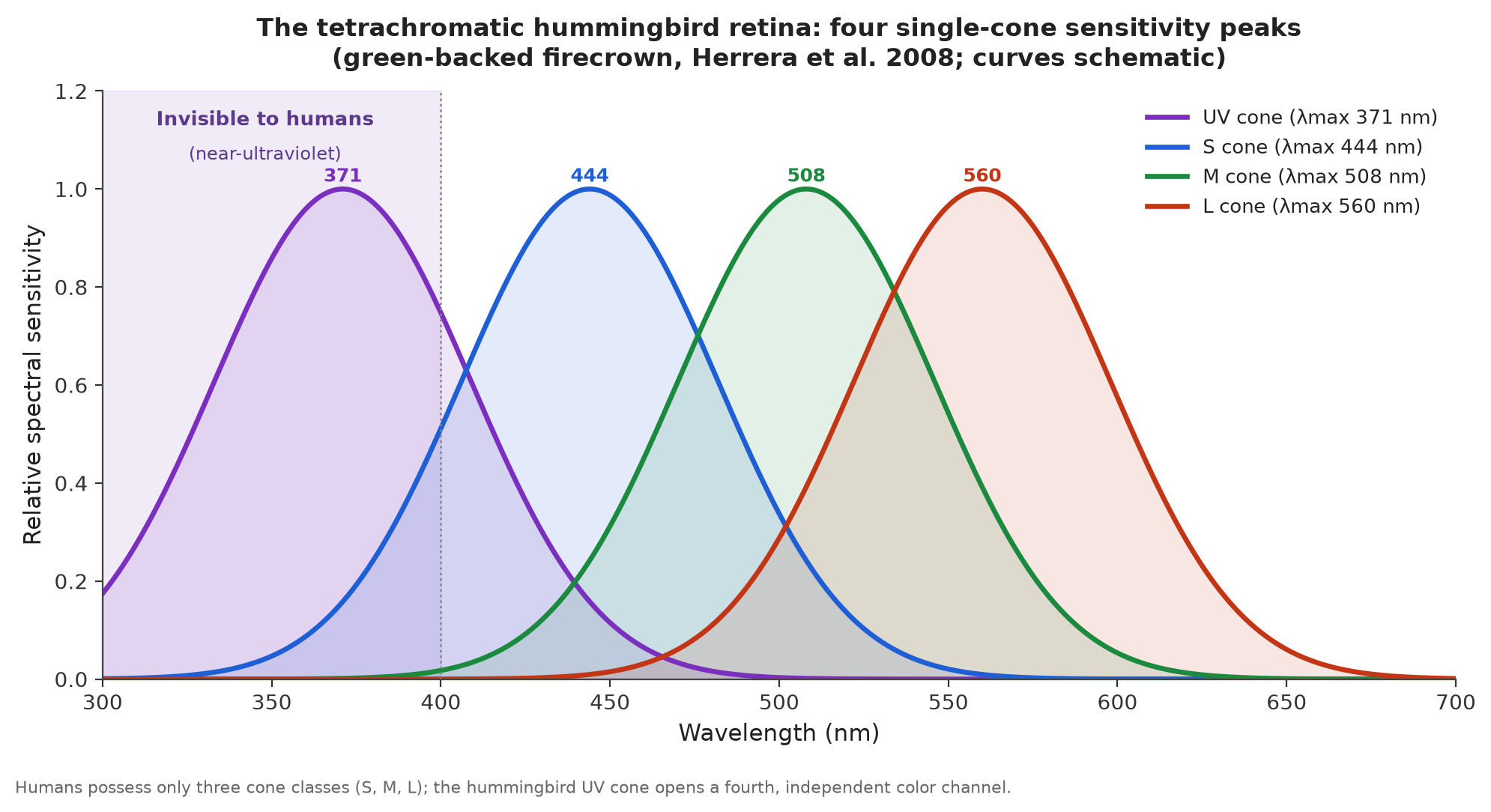
The chart shows the four sensitivity peaks. Note the leftmost curve: it sits almost entirely inside the band humans cannot see at all. That cone is not a minor accessory. It is a full, independent color channel, and it changes the arithmetic of everything downstream.
Why a fourth channel matters mathematically
With three cones, the set of perceivable colors forms a triangle. With four, it forms a tetrahedron — a volume, not a plane. The extra dimension creates whole families of colors that simply have no human equivalent, because producing them requires stimulating the UV cone together with one of the visible cones:
| Nonspectral color | Cones stimulated | Human equivalent |
|---|---|---|
| UV+red | UV + L | None |
| UV+green | UV + M | None |
| UV+yellow | UV + M/L | None |
| UV+purple | UV + S + L | None |
| Purple | S + L | Purple (our only nonspectral color) |
Humans have exactly one nonspectral color: purple. Hummingbirds have at least five.
Oil droplets: a built-in filter set
Bird cones carry colored oil droplets that sit in the light path like tiny filters. Each droplet narrows the range of wavelengths reaching its photopigment, which reduces overlap between cone classes and sharpens color discrimination. It costs sensitivity in dim light and buys precision in bright light — an appropriate trade for a diurnal bird that has to identify a flower's reward status in a fraction of a second.
The Experiment That Proved It
Retinal measurements tell you what a bird could see. Mary Caswell Stoddard's team at Princeton set out to show what wild hummingbirds actually use.
Over three summers at the Rocky Mountain Biological Laboratory, they trained wild broad-tailed hummingbirds with pairs of feeders marked by custom LED tubes capable of emitting UV as well as visible light. One feeder held sugar water; the other held plain water. The rewarding color was switched between trials, feeder positions were swapped to defeat spatial memory, and controls tested whether the birds were using brightness cues instead of hue.
The birds learned nonspectral distinctions — UV+green versus pure green, UV+red versus pure red — and kept performing above chance across nearly 6,000 recorded foraging visits. The team then analyzed a database of 3,315 feather and plant colors and found that roughly 35% of plumage colors and 30% of plant colors measured are nonspectral to a bird. The fourth channel is not an exotic laboratory curiosity. It is most of what a hummingbird looks at.
What This Means for Feeders and Flowers
Red attracts, but the bird is not colorblind to anything else
The persistent backyard belief is that hummingbirds "see red best." What the physiology shows is subtler. The 560 nm L cone gives strong long-wavelength sensitivity, and red is a learned, reliable signal because bees see red poorly — so red flowers advertise to birds with less insect competition. But hummingbirds locate feeders by memory of location far more than by color once a site is established, and they investigate any color that might carry nectar.
This is the practical argument against red dye. The feeder's own red plastic is a sufficient visual signal; the nectar inside does not need to be colored, and there is no benefit to adding a dye a bird cannot metabolize. Our dye-free nectar guide covers the evidence in detail, and the 4:1 recipe is what the birds' physiology actually wants: sucrose and water.
UV markings you cannot see
Many flowers carry ultraviolet nectar guides — bullseyes and runway stripes invisible to us that point straight at the reward. When you plant for hummingbirds you are planting a signal system you can only partially perceive. Native species that evolved with local hummingbirds tend to carry the right ones; that is one reason a native plant garden outperforms an equally colorful ornamental bed.
The gorget is a directional signal
A male's throat gorget is not pigment. It is structural color, produced by stacked layers of melanin-containing platelets that interfere with light. That is why a gorget flares from black to blazing magenta with a few degrees of head rotation: the bird is aiming a beam. Add a UV component invisible to us, and courtship displays carry information we are only partly reading. See our species identification guide for how gorget color separates the common North American species.
The Cost of Seeing This Well
High-acuity color vision in a four-gram animal is expensive. Hummingbirds devote an unusually large share of brain tissue to processing visual motion, including an enlarged lentiformis mesencephali — a nucleus tuned to whole-field motion that helps the bird hold position within millimeters while hovering in moving air. Vision, flight control, and metabolism are one integrated system; the same energy budget described in our physics of hummingbird flight article pays for the eyes too.
Bottom Line
The hummingbird at your feeder is operating a sensory system with a dimension yours lacks, resolving hues that cannot be printed, photographed, or described. It is a good reminder that a garden is not designed for human eyes — and that the simplest, cleanest offering (pure sucrose nectar, no dye, changed often) is the one that respects what the animal is actually built to detect.
Scholarly Sources
- Stoddard, M. C., et al. (2020). "Wild hummingbirds discriminate nonspectral colors." PNAS, 117(26), 15112–15122. https://doi.org/10.1073/pnas.1919377117
- Herrera, G., et al. (2008). "Spectral sensitivities of photoreceptors and their role in colour discrimination in the green-backed firecrown hummingbird." Journal of Comparative Physiology A, 194, 785–794.
- Goldsmith, T. H. (2006). "What birds see." Scientific American, 295(1), 68–75.
- Gaede, A. H., et al. (2017). "Neurons responsive to global visual motion have unique tuning properties in hummingbirds." Current Biology, 27(2), 279–285.
Frequently Asked Questions
Related Articles
Hummingbird Facts
The Physics of Hummingbird Flight: How a Four-Gram Bird Rewrote Aerodynamics
Read article
Hummingbird Facts
The Evolution of Hummingbirds: How Nectar, Mountains, and Flight Built Nature's Most Specialized Birds
Read article
Feeding & Nectar
Is Red Dye Bad for Hummingbirds? What Experts Say
Read article