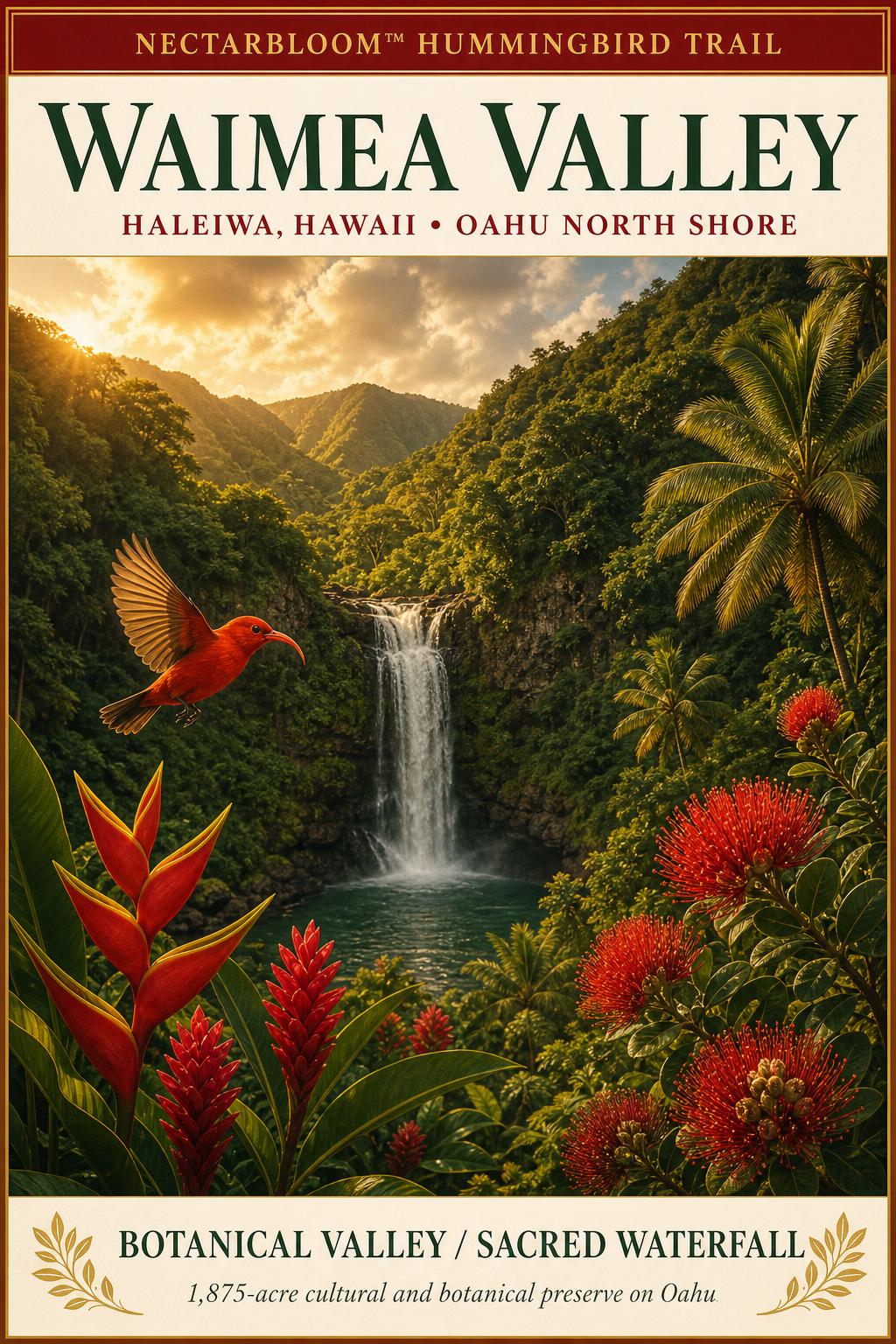
Waimea Valley Hummingbird Guide

    Haleiwa, Honolulu CountyNature PreserveAdmission: Paid

    Shop & Support the Mission

    Fresh nectar in a minute.

    Every bag of NectarBloom™ funds the guides, the Hummingbird Trail, the lab testing, and the free care resources on this site. When you buy our nectar, you help us keep hummingbird education open, honest, and growing — for every bird lover, everywhere.

    NectarBloom 2 lb bag — pure cane sugar hummingbird nectar

    NectarBloom™ — 2 lb Bag

    Fresh nectar in a minute.

    No boiling, no dye. The same sugar hummingbird flowers make. One ingredient, nothing else. Makes up to 160 oz of fresh feeder nectar per bag.

    • Fresh nectar in a minute: measure, stir until clear, and pour
    • No boiling, no dye
    • The same sugar hummingbird flowers make
    • One ingredient, nothing else: 100% pure cane sugar
    • Lab tested. Resealable 2 lb bag, sourced and packed in the USA

    1 Bag · 2 lb

    $21.99

    Free shipping included

    Best Value

    2 Bags · Season Supply

    $39.88

    Free shipping included

    Direct orders are temporarily sold out. NectarBloom™ is still available on Amazon.

    Buy on Amazon

    Ships fast via Amazon Prime

    See full product details

    Direct orders temporarily unavailable

    “Your purchase isn’t just nectar — it’s how we keep this hummingbird care library free, accurate, and growing.”

    Thank you for flying with us

    Overview

    A 1,875-acre ahupuaʻa (traditional Hawaiian land division from mountain to sea) on Oʻahu's North Shore, Waimea Valley is both a world-class botanical garden and a living cultural landscape. The botanical garden spreads across 300 acres featuring over 50 plant collections across 60 themed gardens, with more than 3,000 documented species from 930 genera. The conservation team actively restores native forest on the valley's ridges, planting koa and ʻōhiʻa lehua. The valley is also home to an endangered population of approximately 15 ʻAlae ʻUla (Hawaiian Moorhen) in the wetland estuary — one of only ~500 remaining.

    Hummingbirds to Watch For

    • • ʻAlae ʻUla / Hawaiian Moorhen

    Most Common Hummingbird

    The most commonly sighted hummingbird at Waimea Valley is the ʻAlae ʻUla / Hawaiian Moorhen.

    Special Guest Hummingbird

    Watch for the Japanese White. eye visits ʻōhiʻa blooms in restoration areas

    Best Time to Visit

    Plan your visit during January, February, March, April, May, June, July, August, September, October, November, December for the highest chance of hummingbird sightings. Early morning and late afternoon are typically the most active feeding times.

    Plants and Habitat

    • • ʻŌhiʻa lehua (*Metrosideros polymorpha*) — planted in forest restoration areas throughout
    • • Koa (*Acacia koa*) — restoration plantings on upper ridges
    • • Wiliwili (*Erythrina sandwicensis*) — endemic Hawaiian tree with red or orange nectar flowers
    • • Lama (*Diospyros sandwicensis*) — endemic Hawaiian persimmon
    • • Ti plant / Kī (*Cordyline fruticosa*) — canoe plant in cultural garden sections
    • • Native Hawaiian hibiscus (*Hibiscus* spp.) — Hawaiian Flora Garden collection

    NectarBloom Tip

    Waimea Valley is the most accessible Hawaiian botanical experience for visitors without a car — it's a short drive from Waimea Bay and combines easily with a beach day. The 1.5-mile paved path to the 45-foot waterfall passes through botanical collections; pick up a self-guided tour map at the entrance. The endangered ʻAlae ʻUla (Hawaiian Moorhen) are almost always visible in the estuary wetland near the entrance — arrive 15–30 minutes after opening when they are most active.

    Visitor Notes

    Admission required. Open daily. Swimming at the waterfall requires a life jacket (provided). ADA-accessible paved path to waterfall. Cultural demonstrations available seasonally.

    Map

    ʻAlae ʻUla / Hawaiian Moorhen near ʻŌhiʻa lehua (*Metrosideros polymorpha*) — planted in forest restoration areas throughout at Waimea Valley in Hawaii

    Open in Google Maps

    Reviews and Sightings

    Visited Waimea Valley? Share what you saw — your photos, ratings, and notes help fellow flock-watchers know what to expect.

    Share a Visit

    Sources

    Nearby gardens in Hawaii

    View Foster Botanical Garden in Honolulu, HawaiiHummingbirds at Foster Botanical Garden in Honolulu, Hawaii
    Map

    Honolulu County

    Foster Botanical Garden

    Honolulu

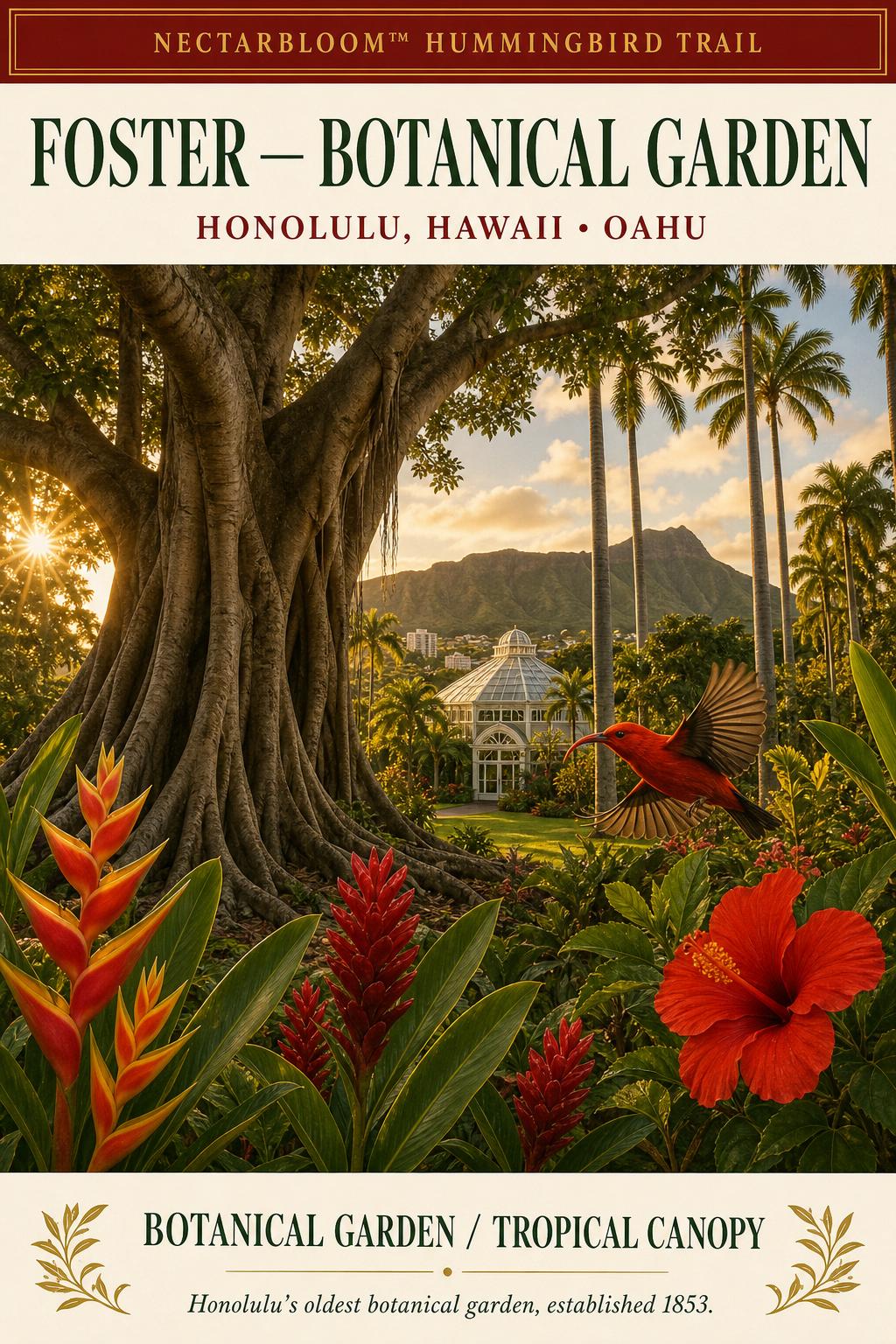
    The oldest of the five Honolulu Botanical Gardens, Foster Botanical Garden was established on land gifted by Queen Kamamalu in 1850 and developed by German botanist William Hillebrand. It occupies 13.5 acres in downtown Honolulu and displays a mature, magnificent collection of tropical plants including rare palms, an outdoor butterfly garden, a Prehistoric Glen of cycads, and 20+ City-designated "Exceptional Trees" — some of the largest specimens of their kind in the United States. As a gateway garden in the heart of Honolulu, it showcases native Hawaiian flora including the loulu fan palm (*Pritchardia* spp.) — the only palm native to Hawaii.

    Botanical GardenʻApapaneJapanese White-eye

    View garden →
    View Harold L. Lyon Arboretum in Honolulu, HawaiiHummingbirds at Harold L. Lyon Arboretum in Honolulu, Hawaii
    Map

    Honolulu County

    Harold L. Lyon Arboretum

    Honolulu

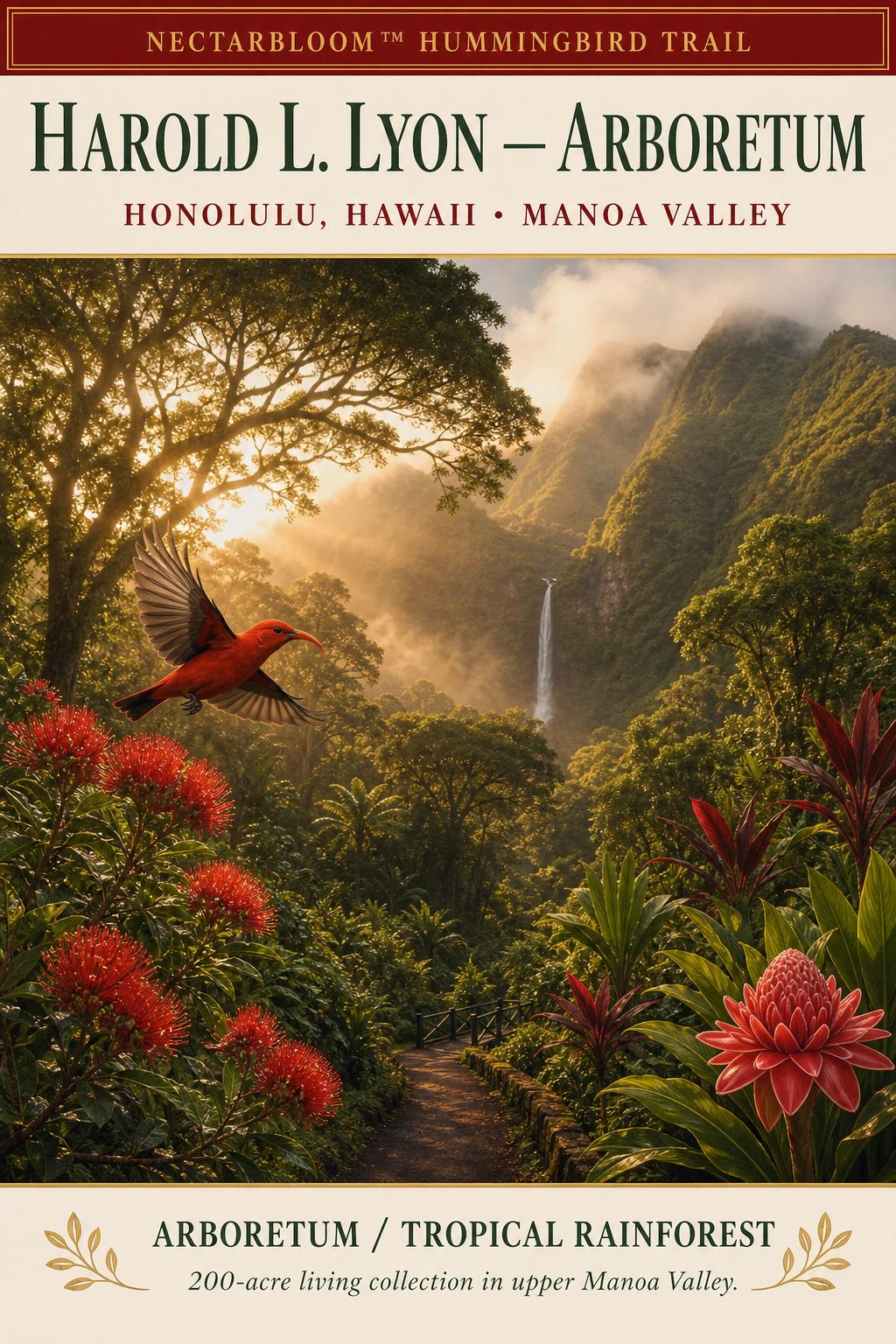
    The only university-run botanical garden in the United States located in a tropical rainforest, Lyon Arboretum is tucked at the back of lush Mānoa Valley on Oʻahu, receiving an average of 165 inches of rain per year. Founded in 1918 and covering 200 acres, it holds more than 5,000 tropical plant species. Its Hawaiian Rare Plant Program — the only micropropagation lab of its kind — has conserved over 300 Hawaiian plant taxa and maintains 16,000+ individual plants of 160 native species. The ʻApapane is occasionally observed flying above the arboretum's ʻōhiʻa trees.

    University ArboretumʻApapane

    View garden →

    Visited Waimea Valley?

    Share your visit — a photo, a rating, and a quick note help fellow flock-watchers know what to expect. No account required.

    Share a Visit

    Fresh nectar in a minute.

    Buy on Amazon